

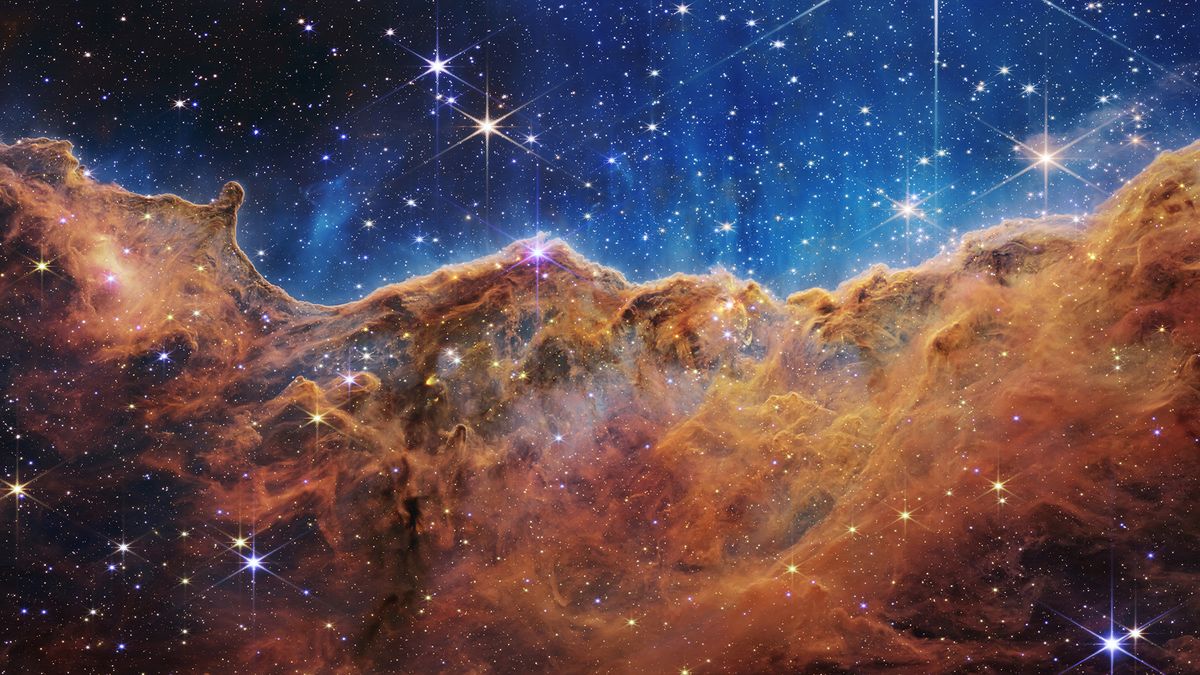
The James Webb Space Telescope has observed the birth of new suns in a distant galaxy. It looked at a feature, which is a network of dust and bright star cluster threads in the galaxy NGC 5068, located about 20 million light years away from Earth. The world’s most potent observatory, whose massive mirror is more than 21 feet wide (over two and a half times larger than Hubble’s), took images of NGC 5068 using its MIRI and NIRCam sensors.
The image highlights a portion of NGC 5068’s central core, full of glowing stars and dusty gas clouds that contain newborn clumps of stars. A massive collection of older stars, also visible in the image, forms an enormous ring around the galaxy’s core. The ring’s edges are bounded by an enormous cloud of dust, which is also illuminated by the newly-forming stars and clusters. Webb’s ability to see through the dust clouds using infrared wavelengths makes it uniquely suited to study star formation since many of these cosmic bodies are born amid swirling, opaque clouds of dust and gas that would be invisible to telescopes that use only visible light, such as Hubble and the Very Large Telescope.
This portrait of NGC 5068 is part of a campaign to gather data about star formation in nearby galaxies that Webb will continue to conduct throughout its lifetime. It’s an essential undertaking for astronomers, who expect major scientific breakthroughs to be kick-started by some of Webb’s earliest observations. The observations are crucial for understanding the physics of the wispy plasma that surrounds stars and enables their formation, how energetic young stars push around their surroundings, and the long-term evolution of entire galaxies.
In the case of NGC 5068, the Webb observation is critical in a more extensive investigation into a pair of colliding galaxies in the constellation Virgo. The scientists who studied the image, which appeared in the April issue of the Astrophysical Journal, used spectrophotometry to measure the temperature and composition of the region in which NGC 5068 is forming stars. This allows them to estimate the star formation rate, which is 20 times higher than that in our Milky Way galaxy.
The image of NGC 5068 is the latest jewel to add to a growing treasure trove of observational gems collected by Webb and gathered by other telescopes, including Hubble. The observatory is collecting images of 19 nearby star-forming galaxies that will be combined with a database of 10,000 infrared observations of these regions taken by Hubble and observations of more than 12,000 star-forming emission nebulae by the Atacama Large Millimeter/Submillimeter Array (ALMA). This effort will help reveal, with unprecedented detail, what takes place in these regions when they collide. The gems Webb will collect will form a foundation for the significant discoveries expected from the observatory in its early career.