

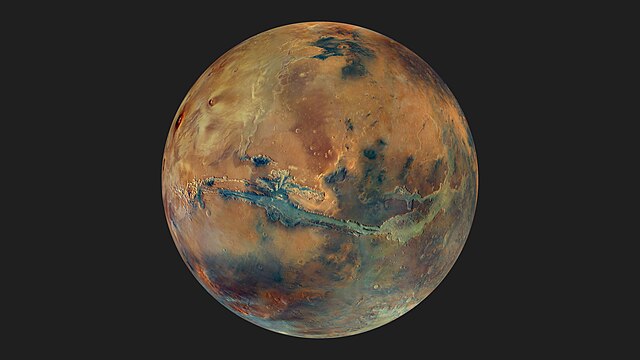
In what could be the future of astronomy, the European Space Agency successfully conducted the first-ever video livestream done from Mars. Europe’s Mars Express hovering above the Red Planet, beamed the video feed, which reached Earth minutes later.
Each picture took nearly 17 minutes to reach Earth, nearly 300 million kilometers away, and another minute to get through the ground stations. But even with the delay, scientists could still get a good look at the planet, including a series of long white clouds stretching over the surface.
The one-hour stream, broadcast to mark the 20th anniversary of the launch of the long-lived Mars Express, displayed a new image of the planet every 50 seconds. The Visual Monitoring Camera captured the pictures on board ESA’s Mars Express, an orbiter also working as a probe for Martian meteorites.
But it was the first time ESA had sent such a stream to the public in near real-time, though the images weren’t that live. Light from Mars takes between three and 22 minutes to travel to Earth, depending on the positions of the two planets and their orbital paths around the sun. That’s why ESA says the images were not technically “live” but close enough.
Usually, pictures and other data from Mars are stored aboard a spacecraft until they can be sent to Earth and analyzed by astronomers. This system is exemplary for scientific missions as astronomers can pore over the data days after the pictures are captured. But beaming live images from deep space is more challenging and technically impressive. It is why there have been just a few historical examples of us seeing real-time footage from other worlds, such as the live videos sent by the Apollo moonwalkers a half-century ago and last year when NASA deliberately crashed a spacecraft into an asteroid to test its defensive capabilities.
About one hour’s worth of images was dispatched from Mars Express before the spacecraft moved too far from Mars to continue capturing it, and scientists said that additional updates would be shared on Twitter. The transmission was sometimes disrupted by rainy weather at the deep space-relay antenna in Spain that relays the signal to and from Mars.
Mars Express is a complex spacecraft designed to gather information about the planet’s atmosphere, surface, meteorites, and underground ice deposits. It’s also been studying the Martian environment for years to understand the chemical makeup of its rocky soil and how it has changed over time as it has accumulated more carbon dioxide and water. The information that Mars Express sends back to Earth is critical in understanding the potential for life on another planet. For now, though, the European Space Agency is happy to offer a glimpse of the Red Planet from an unprecedented perspective. For more, check out the live stream on ESA’s YouTube channel.