

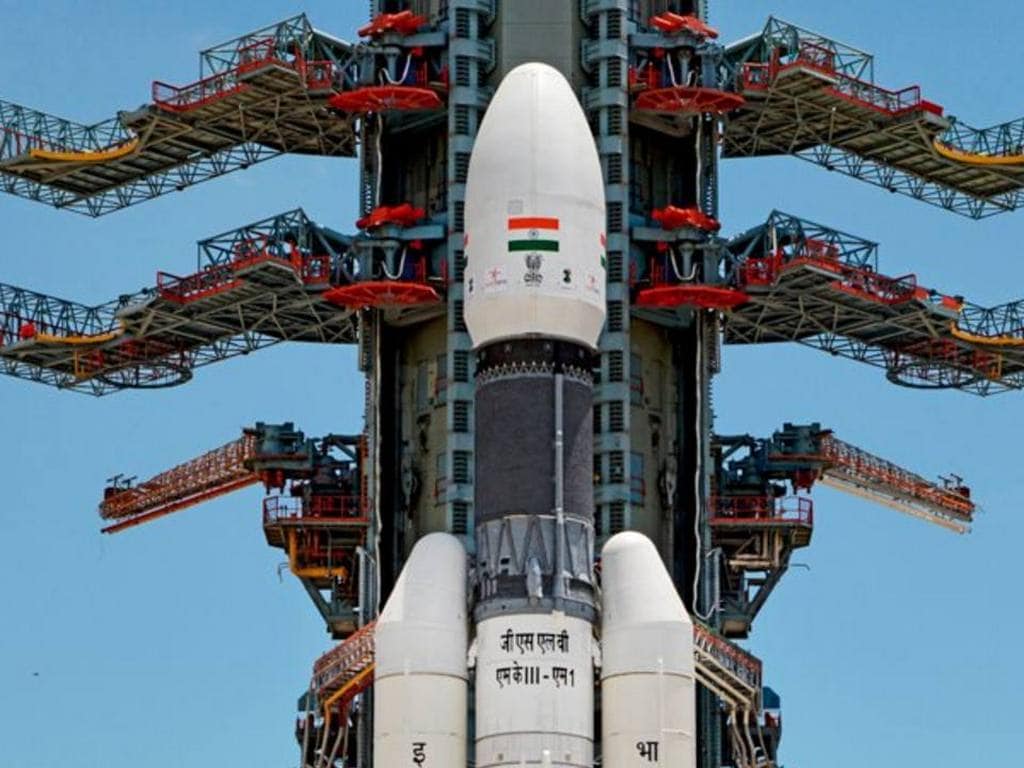
If all goes well, India’s space agency will launch its ambitious mission to the Moon, Chandrayaan 3, next week. The Bengaluru-headquartered national space agency will use its heaviest rocket, LVM3 (earlier Geosynchronous Satellite Launch Vehicle Mark III), to loft the Chandrayaan 3 into an orbit around the Moon for its weeks-long journey to the lunar surface.
The mission is designed to demonstrate critical technologies that can land a scientific payload on the Moon’s southern pole, which no country has touched. It carries scientific instruments to study the thermo-physical properties of the lunar regolith, lunar seismicity, and lunar surface plasma environment.
The lander has been modified to enhance its chances of success, with more fuel and more muscular landing legs. There are also additional sensors to measure its speed, and the new software will help it to change its planned spot if the previous site is unsuitable, ISRO chief S Somanath said. He added that the spacecraft will also carry more scientific payloads than earlier. More extensive solar panels have been fixed to produce more energy, and a laser Doppler velocity meter has been added to measure its speed.
Chandrayaan 3 will make India the fourth nation in the world to make a soft landing on the lunar surface after the US, Russia, and China. The spacecraft will also attempt to collect samples of the Moon’s far side, which is dark and has yet to be explored. The mission will be launched from the Satish Dhawan Space Centre in Sriharikota, where ISRO has already completed the integration of the spacecraft and the rocket at the launch pad.
Somanath, the space agency’s chairman, told PTI news agency that the rocket integration is going on smoothly and will be completed in a few days. He said the best time to launch the spacecraft is between July 12 and 19, when it will lose less fuel due to the planetary dynamics.
He said the Chandrayaan 3 consists of an indigenous lander module, a propulsion module, and a Rover that can conduct in-situ chemical analysis of the Moon. The lander will land at a specified location on the lunar surface and deploy the rover to perform a series of experiments, including measuring the temperature of the Moon’s atmosphere, surface, and lithosphere.
The spacecraft has already been transported to the Satish Dhawan Space Centre from the U R Rao Satellite Centre in Bengaluru, Somanath said. ISRO will announce the exact launch date after all the tests are completed, he added. The lander will carry the scientific payloads – Radio Anatomy of Moon Bound Hypersensitive Ionosphere and Atmosphere (RAMBHA), Chandra’s Surface Thermophysical Experiment (ChaSTE), Instrument for Lunar Seismic Activity (ILSA) and LASER Retroreflector Array (LRA). The orbiter will carry a spectrometer to measure the density of the lunar plasma, among others. The entire mission will cost Rs 1.76 billion. The central government and the state governments of Karnataka and Kerala fund it.