

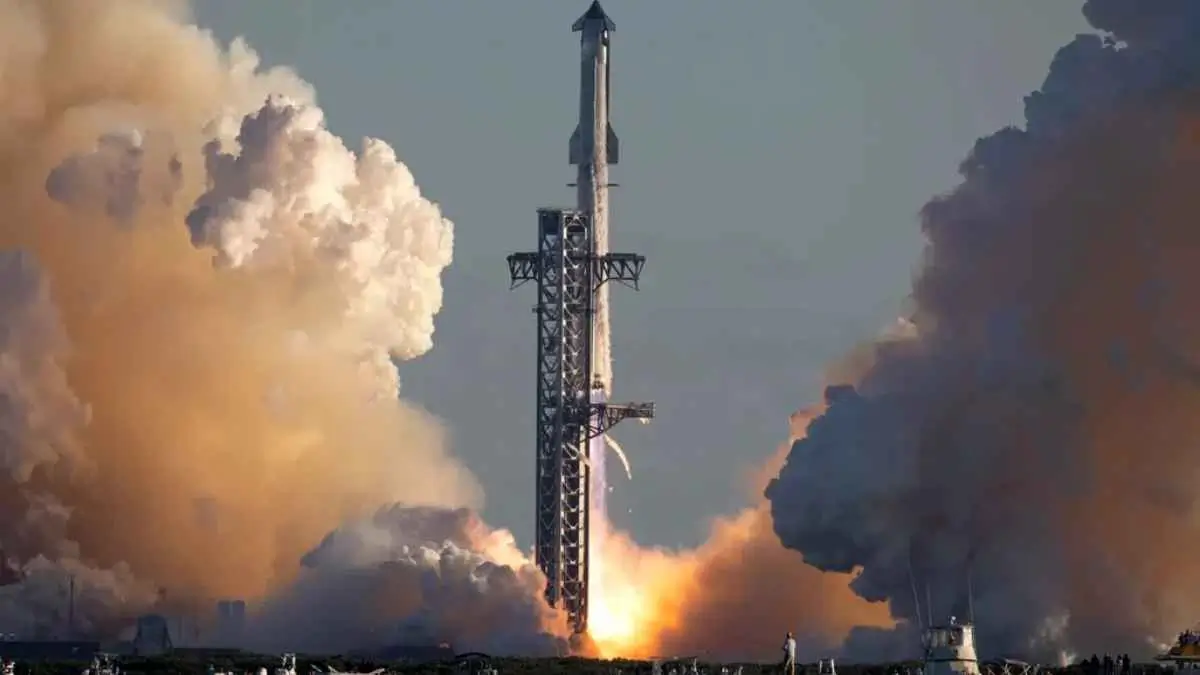
Modern space continues to be expanded as SpaceX’s latest tests have pushed the limits of rocketry. On the 13th November 2026, the Starship spacecraft successfully launched into Earth’s orbit in its latest test flight. Despite a significant failure in the Super Heavy booster, the launch was a significant milestone in the global aerospace industry. While it wasn’t successful in achieving its primary goal of landing both stages of the rocket, many milestones were achieved with the spacecraft. The mission has provided further evidence that SpaceX’s next generation launch system is becoming much more capable. This mission is another milestone on the journey to more affordable, reusable space transport.
A Landmark Launch With an Unexpected Setback
The SpaceX team launched the gigantic Starship rocket from its Starbase facility located in southern Texas on November 13. The Starship rocket, which stands at around 407 feet (124 meters) high when combined with its booster, is still the world’s biggest and strongest rocket.
The test flight number 15 of the fully assembled Starship rocket was supposed to prove that SpaceX could manage a remarkable accomplishment: the recovery of both the Super Heavy first-stage booster and the Starship upper-stage craft with the help of the launch tower arms.
However, problems occurred right after stage separation due to some unknown reason. Flight control personnel had no choice but to give up the plan of booster recovery and guide it into splashing down into the Gulf of Mexico waters, where the booster eventually exploded. Thus, the hopes for the double recovery were destroyed.
Despite the booster failure, the upper-stage Starship managed to reach orbit and proved itself capable of completing the main orbital objective even under such conditions.
Starship Successfully Deploys 26 Starlink Satellites
An important milestone of the mission was the Deployment of 26 Next Generation Starlink V3 Satellites to space. This occurred after they were deployed out of Starship once it reached orbit. This shows the progress SpaceX has made in building their satellite internet service and gives a chance to test the spacecrafts payload delivery capabilities. These Starlink V3 Satellites will give an improvement to SpaceX’s network capacity. This shows Starship is moving away from being an experimental rocket and is becoming a useful vehicle to deliver payloads such as large satellite constellations. The capabilities to deliver and deploy multiple advanced satellites can have a huge impact on the economics of commercial spaceflight.
The First Successful Return and Catch of Starship
Despite the failure to recover the booster, the mission was also a historic success. After circling the earth 14 times in around 22 hours, the Starship capsule successfully completed its entry back into the atmosphere, positioned itself vertically and was caught by the massive robotic arms on the launch tower. This was the first time a Starship capsule had been successfully recovered. The recovery was especially impressive as Starship has to endure extreme temperatures during reentry in addition to having precise control over its descent. It proves that SpaceX could potentially use their recovery technology to catch and reuse the upper part of the spacecraft. Despite not achieving the ultimate goal of having it caught twice, it was a huge achievement.
Why Rocket Reusability Matters for Future Space Exploration
Traditionally orbital rockets have experienced high levels of hardware loss due to the disposal of major components. These increased production costs and limited launch frequency. However, SpaceX are aiming to change this by using completely reusable technology. The Starship consists of two main parts, the Super Heavy booster, and the Starship itself. By retrieving and reusing both parts, SpaceX will be able to cut costs on launches, reduce turnaround time and increase the number of launches. Reusability is a key factor in allowing SpaceX to achieve their goal of creating an economically viable large scale transport system within space. The latest test flight shows progress towards achieving this goal, however the booster failure shows the difficulties that come along with this.
Implications for NASA’s Artemis Program and Mars Exploration
The development of Starship goes far beyond commercial satellite launches. NASA is using a modified version of the vehicle to aid its Artemis lunar programme. The spacecraft is set to play an important role in moving astronauts from orbit around the Moon, to the surface of the Moon. However, NASA are looking at more ways to move people around the Moon to create a long-term human presence there. SpaceX founder Elon Musk sees Starship as key to future manned missions to Mars. This will require further breakthroughs in terms of refuelling in orbit, life support, long-term operation and reliable recovery. Whilst the recent mission in orbit shows some positive steps have been taken, there will still be a lot of work to be done.
What Comes Next for SpaceX?
Starship’s recent launch demonstrates the incredible possibilities and challenges of the modern rocket engineering. Despite the fact that booster malfunction did not allow SpaceX to complete the full cycle of recovery, the orbital flight, satellite delivery, and spacecraft recovery became the landmark for the whole industry. Engineers should examine the reasons for the malfunction of the booster, enhance recovery procedures and prove the efficiency of spacecraft operation through the next test flights.
Eventually, success of Starship does not depend on the outstanding launch; it will be determined by its continuous operation, safety of recovery and reuse. As far as commercial space exploration is developing, the work done by SpaceX might affect the future satellite infrastructure, lunar exploration and human spaceflight. The current launch proved one more time that in spite of any failures, lessons and achievements can lead to the new breakthrough of the whole industry.