

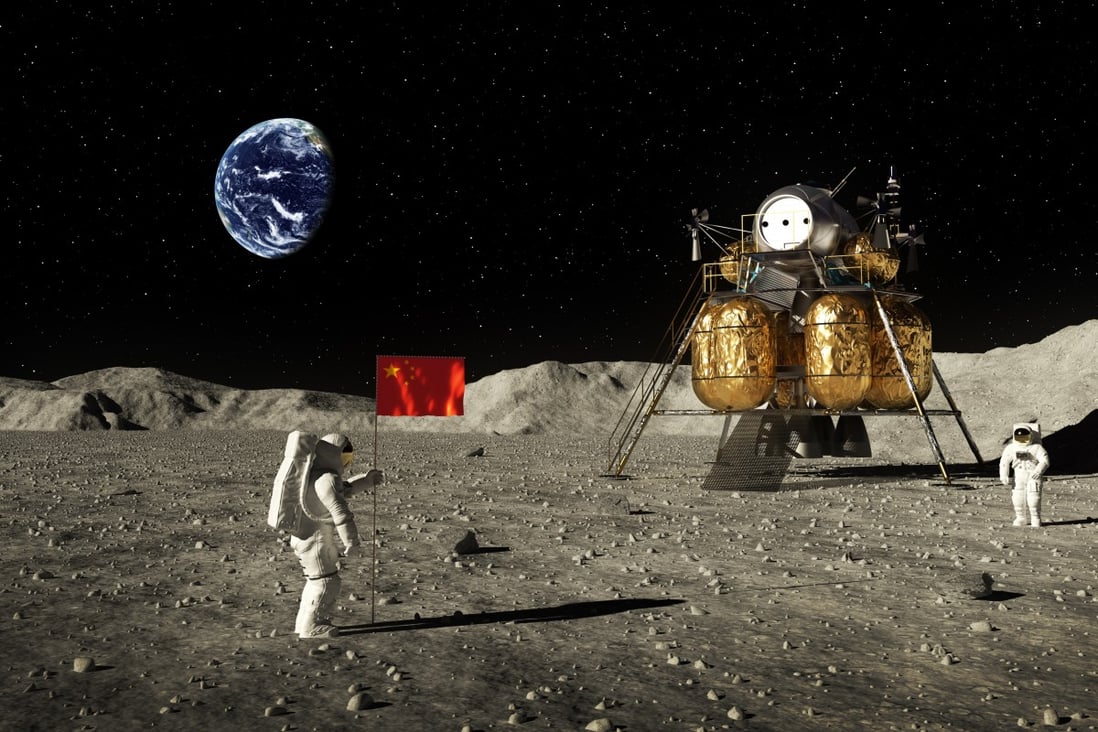
China’s burgeoning space program plans to put astronauts on the Moon by 2030 and expand its orbiting space station. The goal underscores a growing competition between China and the United States to achieve new milestones in outer space as the world’s two largest economies compete for influence on Earth. It also echoes the 1960s and 1970s race between the U.S. and the former Soviet Union. However, America’s superior capabilities, funding, and supply chains give it a significant advantage in reaching space goals for now.
The lunar exploration plan calls for a dual-rocket system, with one rocket carrying the spacecraft that will land on the surface and the other transporting the astronauts. Once the astronauts reach the Moon’s orbit, they will enter the lunar lander to descend onto the Moon’s surface. After completing the mission, the astronauts will return to the orbiter, which will return to Earth, state media reported on Wednesday, citing a China Manned Space Agency engineer.
Chang’e-5 is scheduled to touch down on the far side of the Moon at Mons Rumker, a massive basalt lava plain billions of years younger than rock samples retrieved by Apollo astronauts in the 1970s. The lander will collect the samples, transfer them to a lunar orbiter, and then dock with the returner to carry them back to Earth for analysis. The returner will use a “skip reentry” technique, bouncing off the Moon’s atmosphere once to cope with its fast reentry speed.
The mission would mark the first time a spacecraft has landed on the far side of the Moon and the first time a country has done so in nearly three decades. It would also mark a significant step toward China’s ambition to build a permanent lunar base, envisioned as a critical next step after the nation was excluded from the International Space Station a decade ago primarily due to the U.S.’s concerns over its secretive and military-linked space program.
Space exploration is a significant source of pride for China, which became only the third nation to independently carry out a lunar soft landing in 2012, after the United States and the Soviet Union. But it’s still an immense technological challenge to land a vehicle on another planet, and the twin-rocket plan is crucial to overcoming that hurdle.
The mission’s designers are also working on a three-stage, super-heavy rocket known as the Long March 9, which could eventually allow for crewed missions to the Moon and other deep-space destinations. According to reports in the Chinese press, the Long March 9 is expected to make its debut engine test later this year. If all goes well, the rocket could be ready to fly people into orbit by 2025. That’s eight years ahead of schedule, but experts say it’s still too soon to declare victory in a race for the far side of the Moon.